
You negotiated $100,000. Then the first payslip arrived and the number was smaller than the arithmetic in your head. Here is exactly where the difference goes, and the one figure that should change how you negotiate your next rise.
How much tax do you pay on $100,000 in Australia?
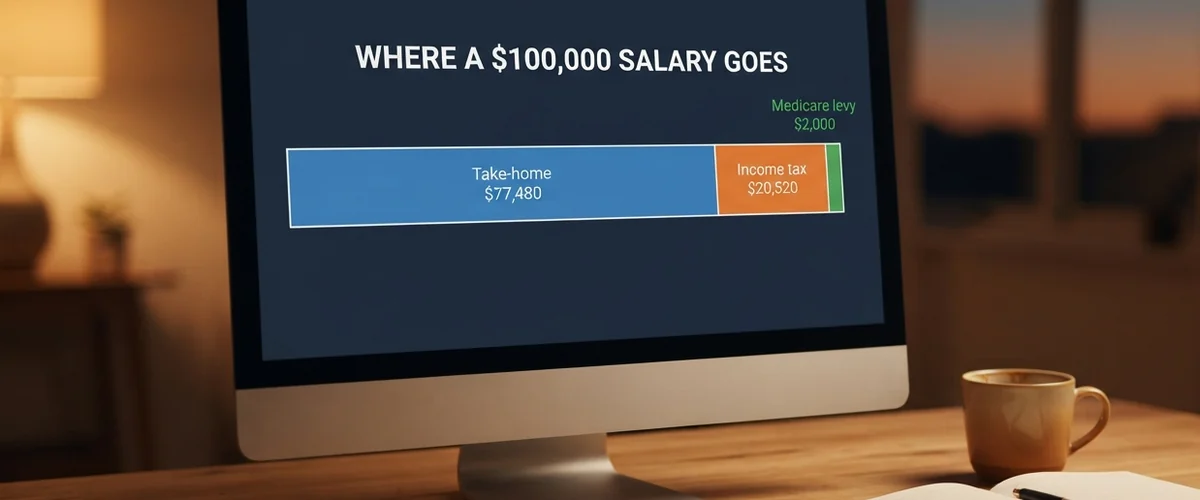
On a $100,000 salary you pay $20,520 in income tax plus $2,000 Medicare levy — $22,520 in total, an effective rate of 22.5%. That leaves about $77,480 a year, or $6,457 a month. Superannuation of 12% is paid by your employer on top, not deducted from it.
The bracket-by-bracket breakdown
Australia taxes income in slices. Nobody pays their top rate on their whole salary — a point worth remembering the next time someone tells you a rise will “push you into a higher bracket and cost you money”. It cannot.
| Slice of income | Rate | Tax on this slice |
|---|---|---|
| First $18,200 | Nil | $0 |
| $18,201 – $45,000 | 15% | $4,020 |
| $45,001 – $100,000 | 30% | $16,500 |
| Income tax | $20,520 | |
| Medicare levy | 2% | $2,000 |
| Total | $22,520 |
What actually lands in your account
| Line | Amount |
|---|---|
| Base salary | $100,000 |
| Income tax | −$20,520 |
| Medicare levy | −$2,000 |
| Take-home (no HELP debt) | $77,480 |
| Per month | $6,457 |
| Per fortnight | $2,980 |
| Superannuation (12%, on top) | +$12,000 |
| Total package | $112,000 |
What a HELP debt does to it
Compulsory HELP repayments start above $67,000 of repayment income. At $100,000 the repayment is about $4,950 a year, cutting take-home to roughly $72,530 — around $6,044 a month. That is a real $412 a month, and it is the single most common reason a six-figure salary feels thinner than expected.
The number that should change how you negotiate
Your marginal rate at $100,000 is 30% plus the 2% levy, so the next dollar you win is worth 68 cents. A $10,000 rise nets you about $6,800 a year. That cuts both ways, and most people take the wrong lesson from it.
- The wrong lesson: “a rise is barely worth chasing”. $6,800 a year is a holiday, or a year of a car loan, every year, forever.
- The right lesson: raises compound. That $10,000 lifts the base every future percentage rise is calculated on, and it anchors the offer at your next job.
- The practical lesson: ask for the base, not the bonus. A one-off bonus pays you once and is taxed the same way; base keeps paying.
This is also why “$120k package” and “$120k plus super” are not the same job. If you are comparing offers, get them into the same units first — base, package and OTE explained.
Is $100,000 still a good salary after tax?
It is above the middle. $100,000 sits near the 53rd percentile for full-time non-managerial adults, so after tax you are taking home more than about half of Australia — but not dramatically more. The full context is in is $100,000 a good salary in Australia and the Australian salary percentile table.
Before your next review, check where your pay sits against the market — free, anonymous, about a minute. A percentile is the evidence; how to ask for a pay rise is the conversation.
Tax takes 22.5% of a $100,000 salary and 32 cents of the next dollar. Neither is a reason to stop asking for the next dollar.
Rates are the legislated resident rates for 2026–27. Check the current figures with the ATO. This is general information, not tax or financial advice.