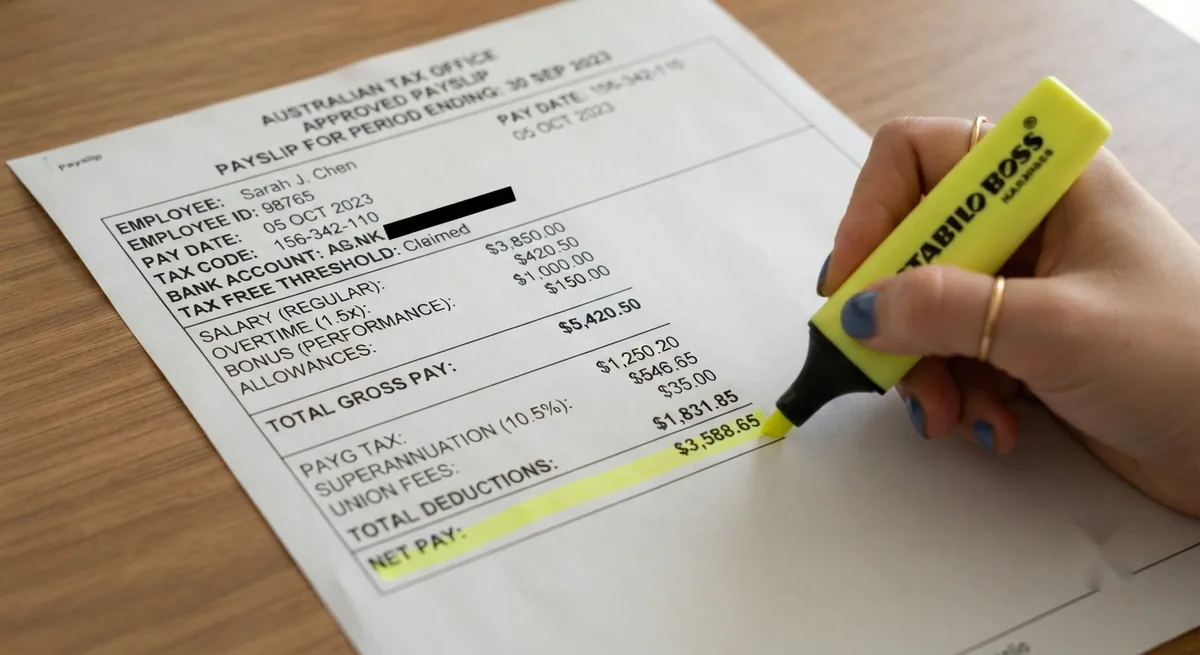

A job ad quoting “$180,000 OTE” is quoting a number that may never appear in your bank account. Variable pay is real money, and it is also the part of an Australian package most likely to be oversold. Here is how to read it.
What does OTE mean in an Australian job ad?
OTE stands for on-target earnings — base salary plus the commission or bonus you would earn if you hit 100% of target. It is a projection, not a guarantee. The only number in an OTE figure that is contractually yours is the base, so always ask for the split.
The three kinds of variable pay
| Type | How it works | How reliable |
|---|---|---|
| Commission | A percentage of revenue or margin you generate | Most controllable — it tracks your own output |
| Individual bonus | Paid against your personal objectives | Moderate — depends on how the objectives are written |
| Company or profit-share bonus | Paid against company performance | Least controllable — a good year for you can still pay nothing |
The further the trigger sits from your own work, the more you should discount it when comparing offers. A company-wide bonus in a business you cannot influence is closer to a possible gift than to compensation.
The question that reveals everything
Not “what is the bonus?” but “what percentage of target did the team actually achieve last year, and what did that pay?”
A good employer answers immediately with a number. A vague answer, a story about an unusual year, or a redirect to the target figure tells you what you need to know. If nobody hit target last year, the OTE in the ad is decoration.
Why base wins the negotiation
- Base compounds. Next year’s percentage increase is calculated on it, and your next employer anchors to it. A bonus pays once and resets.
- Base is certain. It arrives whether or not the quarter went well, whether or not the target was moved, and whether or not you were on leave.
- Base is what benchmarks measure. Almost all published Australian salary data — including ABS and Jobs and Skills Australia — measures earnings, not target earnings. Comparing your OTE to a market median is comparing two different things.
- Super follows ordinary time earnings. Bonus treatment varies, so a dollar of base and a dollar of bonus are not always worth the same in superannuation terms.
None of that means refusing variable pay. It means negotiating base first and treating the rest as upside — the same principle set out in base, package and OTE.
How bonuses are taxed in Australia
A bonus is ordinary income, taxed at your marginal rate like the rest of your salary. Employers often withhold at a higher rate on a lump sum, which is why a bonus frequently looks over-taxed on the payslip — that generally evens out at tax time. It does not, however, make a bonus more tax-effective than base. It is not.
Reading an OTE offer properly
- Split it. “$180,000 OTE” with a $110,000 base is a $110,000 job with upside. Compare it to other roles on the $110,000.
- Ask for last year’s actual. Target achievement across the team, and what it paid.
- Check the mechanics. Is commission capped? Is it paid on invoice or on collection? What happens to it if you leave mid-quarter?
- Check who controls the target. If the employer can reset it unilaterally each year, the OTE is an estimate they are allowed to change.
- Benchmark the base. Run a free salary check on the base alone, since that is what market data measures.
On-target earnings are what happens if everything goes to plan. Base salary is what happens otherwise. Negotiate the second one.
Australian earnings data referenced from ABS Employee Earnings (August 2025). Tax treatment per the ATO — general information, not tax advice.