
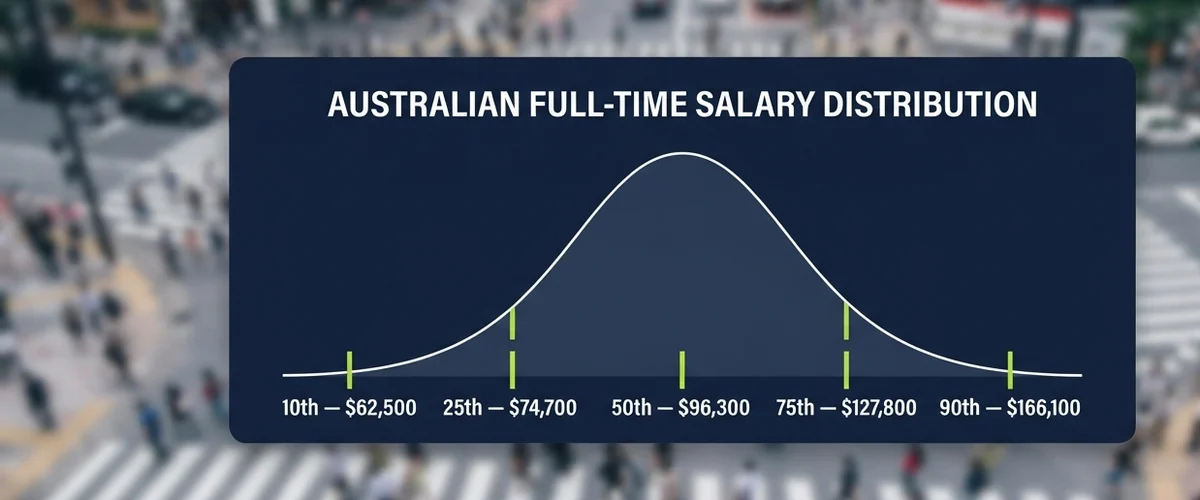
“Is $95,000 a good salary?” is the wrong question, and it is the one almost everyone asks. Good compared to whom? A percentile answers it properly: it tells you what share of Australian workers you out-earn. Here is the whole ladder, from the ABS, and how to find your rung on it.
What salary percentile am I in Australia?
Your percentile is the share of workers earning less than you. Among full-time non-managerial adult employees, the middle sits at about $96,300 a year. Earn $74,700 and you are near the 25th percentile; $127,800 puts you at the 75th; $166,100 puts you in the top 10%. Those are ABS figures, not estimates.
The Australian salary percentile table
This is the published ladder — weekly total cash earnings for full-time non-managerial adult employees, annualised at 52 weeks. It excludes managers and juniors on training rates, which makes it the fairest comparison for a working professional on a salary.
| Percentile | Weekly | Annual (×52) |
|---|---|---|
| 10th | $1,202 | $62,500 |
| 20th | $1,351 | $70,300 |
| 25th (bottom quartile) | $1,436 | $74,700 |
| 30th | $1,510 | $78,500 |
| 40th | $1,668 | $86,700 |
| 50th (median) | $1,852 | $96,300 |
| 60th | $2,062 | $107,200 |
| 70th | $2,314 | $120,300 |
| 75th (top quartile) | $2,458 | $127,800 |
| 80th | $2,640 | $137,300 |
| 90th | $3,194 | $166,100 |
Two things jump out. The bottom half of the ladder is compressed — only about $34,000 separates the 10th percentile from the median. The top half is not: another $70,000 separates the median from the 90th. Pay does not rise evenly. It rises slowly, then steeply, which is exactly why the difference between a good and a bad negotiation compounds so hard.
What your salary is worth in percentile terms
Round numbers people actually search for, placed on the ladder above. These are interpolated between the published percentiles, so treat them as close rather than exact.
| Annual salary | Roughly the… | You out-earn |
|---|---|---|
| $70,000 | 19th percentile | about 1 in 5 |
| $75,000 | 25th percentile | about 1 in 4 |
| $85,000 | 38th percentile | about 2 in 5 |
| $96,300 | 50th percentile | half |
| $100,000 | 53rd percentile | just over half |
| $120,000 | 70th percentile | about 7 in 10 |
| $130,000 | 76th percentile | about 3 in 4 |
| $150,000 | 84th percentile | about 5 in 6 |
| $166,100 | 90th percentile | about 9 in 10 |
Why the national median is not your median
A national percentile is a useful reality check and a terrible negotiating tool. It mixes a graduate in Hobart with a mining engineer in Perth. Two numbers show how fast the ladder moves once you cut it:
- By state. Full-time median pay runs from $83,200 a year in Tasmania and South Australia up to $98,800 in Western Australia — a $15,600 spread for the same national “middle”.
- By industry. The mining median is about $147,000 a year while retail and hospitality sit near $67,600. Same country, more than double the pay.
- By qualification. Bachelor-degree holders have a full-time median near $98,800; people with no post-school qualification sit near $72,800.
So being “above the national median” can still mean being underpaid by $30,000 for your actual role. The number that matters is your percentile inside your own segment — your job, your city, your level.
How to find your own percentile
You can approximate it from the table above in ten seconds. To get the real one, run a free salary check: enter your role, city and salary, and SalariQ places you against Australian market data and returns your percentile and a deal score in about a minute. No signup, no email, anonymous.
Then read the result like a negotiator, not a scorekeeper:
- Below the 40th percentile for your role. There is a documented gap. That is a correction to market, not a favour to ask for.
- Between the 40th and 60th. You are fairly paid. Push on scope, title and the next band rather than on the current one.
- Above the 75th. Protect it. Know your floor before you take any call from a recruiter.
When you are ready to use the number, the case-building is covered in how to ask for a pay rise, and the warning signs are in how to actually know if you are underpaid.
A salary is a number. A percentile is an argument. Only one of them survives a conversation with a manager.
Figures are from ABS Employee Earnings and Hours (May 2025) and ABS Employee Earnings (August 2025).