
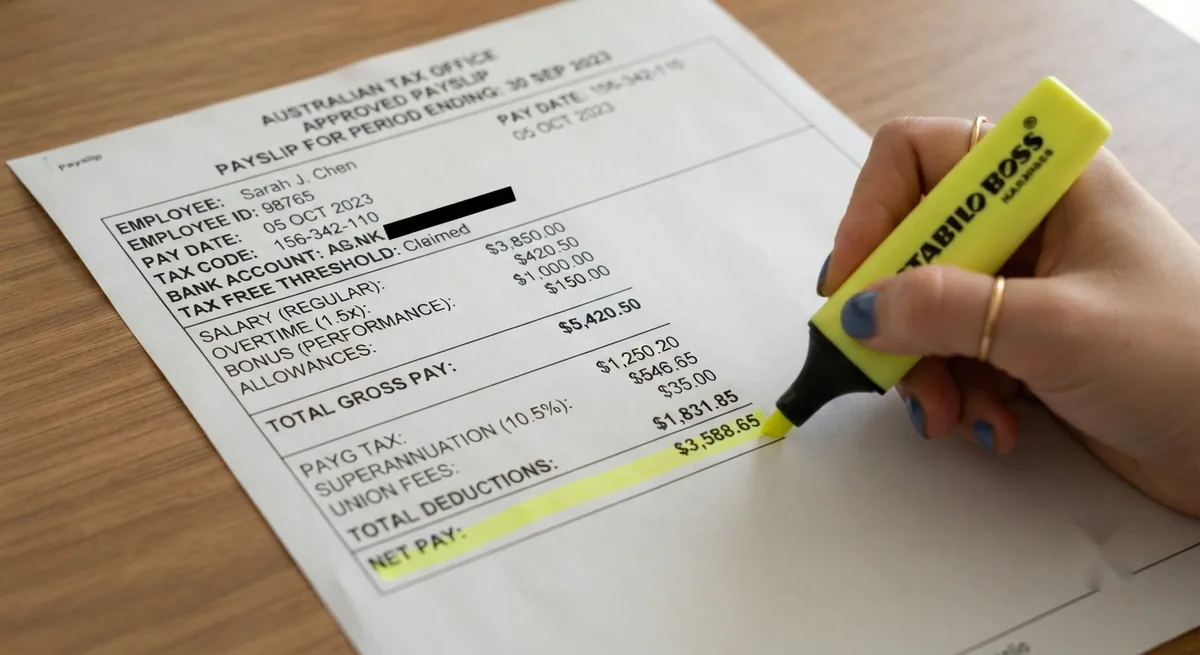
Salary sacrifice is one of the few genuinely legitimate ways to change what you take home without changing what you earn. It is also badly explained, occasionally mis-sold, and easy to get wrong. Here is the mechanism, plainly, so you can ask better questions of someone qualified to advise you.
This is general information, not financial, tax or legal advice. Salary sacrifice arrangements have real consequences for tax, benefits and borrowing capacity. Talk to a registered tax agent or licensed adviser before entering one, and check current rules and caps with the ATO.
What is salary sacrifice in Australia?
Salary sacrifice is an agreement to give up part of your future salary in exchange for a benefit your employer provides instead. The sacrificed amount is not paid to you as wages, so it is not taxed at your marginal income tax rate — though many benefits attract fringe benefits tax paid by the employer instead.
The three things people actually sacrifice
| Arrangement | How it saves | Main catch |
|---|---|---|
| Additional superannuation | Contributions taxed at the concessional super rate rather than your marginal rate | Annual concessional cap; money is locked until preservation age |
| Novated car lease | Lease and running costs come from pre-tax income | Fringe benefits tax, interest and fees can erase the saving on the wrong car |
| Employer-provided work items | Certain work-related items may be FBT-exempt | Must be primarily for work use and meet ATO conditions |
| Not-for-profit / hospital benefits | Eligible employers have FBT-exempt caps for general living expenses | Only available to specific employer types |
Note the pattern: the saving is the difference between your marginal tax rate and the rate that applies to the benefit. That means salary sacrifice is worth substantially more at a 45% marginal rate than at 15%, and can be worth close to nothing at the bottom of the scale.
Where it goes wrong
- Sacrificing when your marginal rate is low. If the benefit is taxed at a rate close to your marginal rate, you have locked money away for very little gain.
- Reportable fringe benefits. Some sacrificed amounts still appear on your income statement and count toward income tests for HELP repayments, family payments and the Medicare levy surcharge. Lower taxable income does not always mean lower everything.
- Borrowing capacity. Lenders assess income. A large ongoing sacrifice can reduce the amount you can borrow, which matters if a mortgage is anywhere in the next few years.
- Sacrificing your super guarantee. Your employer’s compulsory contributions should be calculated on your pre-sacrifice salary. Check the arrangement does not quietly reduce them.
- Novated leases on the wrong car. The advertised saving usually assumes high running costs and a specific vehicle type. Run the numbers on your actual car and your actual kilometres.
The comparison worth making first
Salary sacrifice adjusts the tax treatment of money you already earn. Negotiating adjusts the amount. At a 32% marginal rate — where a $100,000 earner sits — a $10,000 pay rise is worth about $6,800 in the hand, permanently, and it compounds through every future percentage increase. Very few sacrifice arrangements match that, and none of them compound.
They are not alternatives, and the order matters: fix the salary first, then optimise how it is paid. Check where your pay sits against the market free, then work through how much tax you pay on $100,000 to see what a rise is actually worth to you.
Questions to ask before you sign
- Is my employer’s super guarantee still calculated on my pre-sacrifice salary?
- Will this appear as a reportable fringe benefit on my income statement?
- What is the total cost including fees, interest and FBT — not the headline saving?
- What happens to this arrangement if I leave or am made redundant?
- Does this change my HELP repayment, family payments or borrowing capacity?
If the person offering the arrangement cannot answer all five plainly, that is your answer.
Salary sacrifice changes how your money is taxed. A pay rise changes how much of it there is. Only one of those compounds.
Rules, caps and thresholds are set by the ATO and change between financial years. This page is general information only and does not take your circumstances into account.