
Two people with the same skills, the same hours and the same years of experience can be $80,000 apart because of the industry printed on their payslip. Here is the full Australian ranking, and the honest read on whether switching is worth it.
Which industry pays the most in Australia?
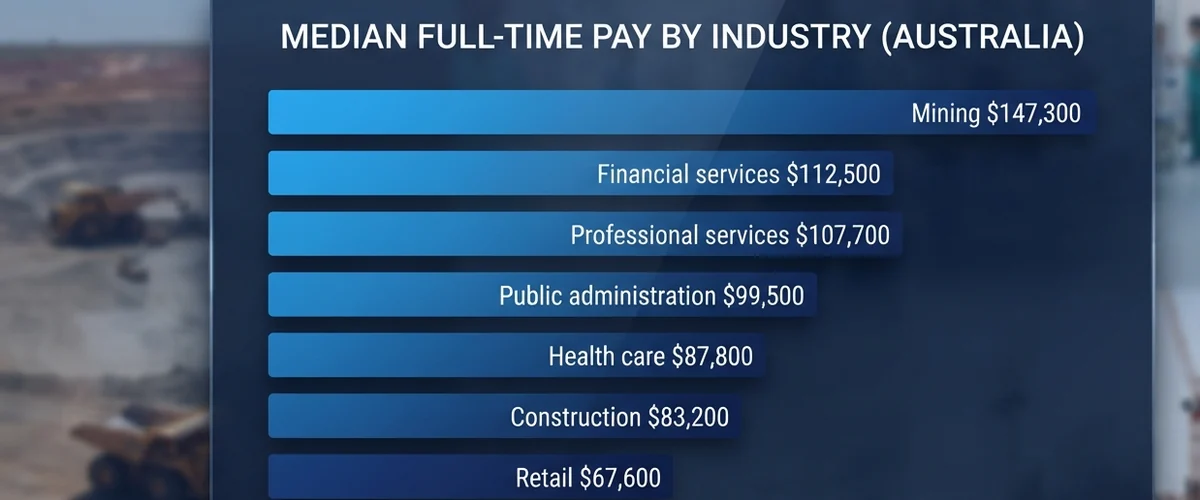
Mining, by a wide margin. The median full-time worker in mining earns about $147,300 a year, against $67,600 in retail trade and accommodation and food services. That is a gap of nearly $80,000 between the top and bottom industries, on ABS data for August 2025.
Median full-time pay by industry
| Industry | Weekly | Annual |
|---|---|---|
| Mining | $2,832 | $147,300 |
| Financial and insurance services | $2,163 | $112,500 |
| Electricity, gas, water and waste | $2,134 | $111,000 |
| Professional, scientific and technical | $2,071 | $107,700 |
| Public administration and safety | $1,913 | $99,500 |
| Education and training | $1,903 | $99,000 |
| Information media and telecommunications | $1,875 | $97,500 |
| All industries | $1,741 | $90,500 |
| Arts and recreation services | $1,713 | $89,100 |
| Rental, hiring and real estate | $1,700 | $88,400 |
| Health care and social assistance | $1,689 | $87,800 |
| Manufacturing | $1,654 | $86,000 |
| Transport, postal and warehousing | $1,608 | $83,600 |
| Construction | $1,600 | $83,200 |
| Wholesale trade | $1,588 | $82,600 |
| Administrative and support services | $1,494 | $77,700 |
| Other services | $1,400 | $72,800 |
| Agriculture, forestry and fishing | $1,358 | $70,600 |
| Retail trade | $1,300 | $67,600 |
| Accommodation and food services | $1,300 | $67,600 |
What the ranking is really measuring
Not generosity. Three things drive most of the spread, and knowing which one applies to you decides whether a switch would actually pay:
- Capital intensity. Mining, utilities and finance produce a lot of revenue per employee, so there is more to share. That is structural and it is not going to change.
- Skill mix. Professional services and ICT medians are high partly because the workforce is disproportionately degree-qualified. The industry looks well paid because of who works in it.
- Conditions and location. A large slice of the mining premium is remote work, rosters and long weeks. It is paid for something.
That last one matters most for anyone reading the top of the table as a career plan. The premium at the top of the Australian market is frequently a premium on hours and location, not purely on skill.
Is switching industries worth it?
Sometimes, and the arithmetic is more favourable than people expect because the effect compounds. Moving from a $83,200 construction median to a $107,700 professional services median is $24,500 a year — but it also resets the base every future percentage rise multiplies. Over five years that is usually well past $150,000 in cumulative earnings.
Against that: you often re-enter a level or two down, and industry medians are wide. The top quartile of a “low-paying” industry beats the bottom quartile of a high-paying one comfortably. Before treating the table as a plan, find out where you sit inside your current industry — run a free salary check and compare your percentile, not just your salary.
The more useful move for most people
Most of the gap people can actually close is inside their own sector, not across sectors. The spread between the 25th and 75th percentile nationally is $74,700 to $127,800 — $53,100 of range for people who are, broadly, doing similar work. Closing part of that is a conversation. Changing industry is a career.
If your own number is behind, start with how to actually know if you are underpaid, then how to ask for a pay rise. For the full context on where any salary sits, see the Australian salary percentile table.
The industry gap is $80,000 wide. The gap inside your own industry is $53,000 wide — and it is the one you can close this quarter.
Figures from ABS Employee Earnings (August 2025) and ABS Employee Earnings and Hours (May 2025).